
Conducting Plan, Do, Study, Act cycles
Having completed a Driver Diagram and decided which 'Secondary Driver' you are going to try and adapt and improve, you then need to 'test' this change to see if it does actually lead to an improvement.
The Plan Do Study Act (PDSA) cycle is a structured method of doing this, which encourages you to review and adapt the change if necessary before it is adopted or ultimately discarded.
The four elements of a PDSA cycle are:
- Plan - What is your SMART aim? What test of change do you want to try? What do you expect to happen? How will this be measured?
- Do - How are you going to conduct this 'test'? - Who, what, when?
- Study - Analyse the results. Were your predictions achieved? Did the test run smoothly?
- Act - Are you going to adopt the change? Does it need to be adapted or rejected. In most cases there will be a need for further PDSA cycles to be conducted.
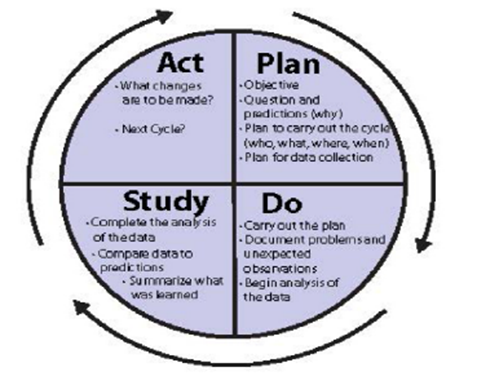
Changes need not be big; often a small change can have a big impact. Additionally, do not be despondent if all changes do not lead to an improvement. The information you have gathered during the test is still extremely useful.
Remember: All improvement requires a change, but not all changes will lead to an improvement!
You need to continually review progress during a PDSA cycle to ensure it is improving the situation. You may notice a situation similar to the graph below, where an initial improvement is noted, but then things start to 'level off'. In these situations, a slight 'tweak' to the change may be needed, or you may need to introduce a further additional change in order to achieve your SMART aim.
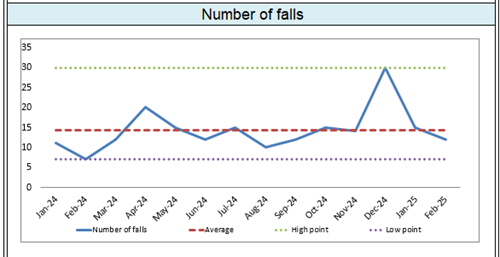
It can often be tempting to abandon a change, and go back to the previous situation, if an improvement is not immediately evident. However, the structure of a PDSA cycle forces consideration of re-testing the change with a slight 'tweak' or addition, rather than 'casting it aside'. It is unlikely that any of the great inventions throughout history worked perfectly at the first attempt.