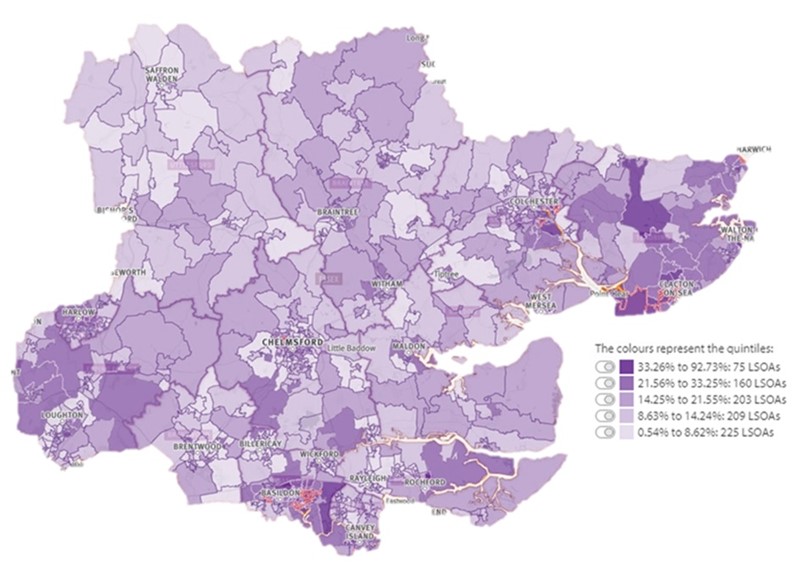
Essex Areas of Deprivation
The map provides a visual representation of Essex’s levels of deprivation. Our key areas are in Uttlesford, Basildon, Rochford, and Tendring. This is comparable to dense population of children and young people, to the level of looked after children in Essex.
This map shows area of known deprivation across Essex in 2020/21.
Data Source: Indices of Multiple Deprivation (2019)
Department for Levelling Up, Housing & Communities
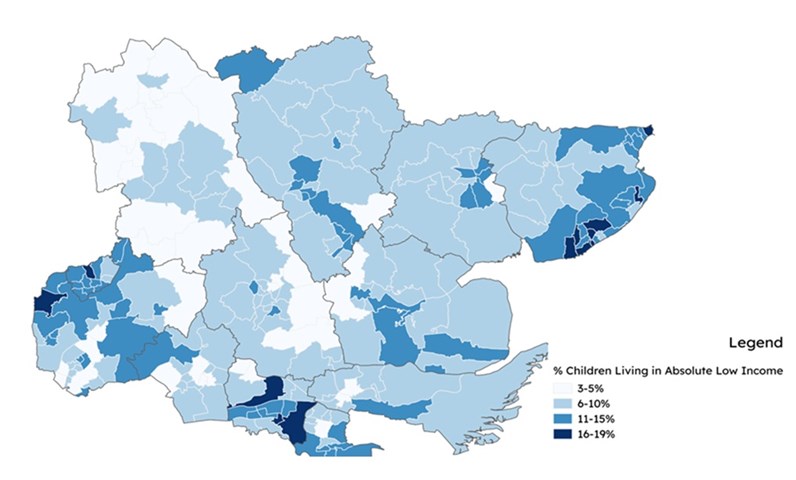
The map below shows the proportion of 0-19 year olds living in Absolute Low Income by ward.
Absolute Low Income
Refers to people living in households with income below 60% of median income in a base year. This measurement is adjusted for inflation.
- 10% of 0-19 year olds in Essex are living in Absolute Low Income as of 2021/22.
- Rises to as high as 19% in some areas of Tendring, Basildon and Harlow.
How will the rising cost of living affect poverty?
Absolute low income is likely to rise in the short run. The Resolution Foundation, an independent think tank, forecasted in January 2023 that absolute low income will increase from 17.2% in 2021/22 to 18.3% in 2023/24. This means an additional 800,000 people nationally in absolute low income.
Data Source: Absolute Low Income (2021/22)
Department for Work and Pensions
This image is a geographical representation of Essex showing areas of Children living in low income families.